

Article Text
 PDF
PDF
Abstract
Objective: To assess the mortality risks from injuries for smokers and ex-smokers and to quantify the mortality burden of smoking from injury in Taiwan.
Methods: Smokers’ (and ex-smokers’) mortality risks from injuries were compared with that of non-smokers in a merged cohort from Taiwan. A total of 64 319 male subjects were followed up for 12–18 years. Relative risks (RR) (adjusted for age and alcohol use) and 95% confidence intervals (CI) for cause specific injury deaths were calculated using the Cox proportional hazard model. Relative risks of injury mortality were also calculated to assess the presence of dose–response relations with daily smoking quantity.
Results: Alcohol use adjusted relative mortality risks for all injuries (RR 1.69, 95% CI 1.39 to 2.05) including those from motor vehicle accidents (RR 1.88, 95% CI 1.44 to 2.45) and non-motor vehicle accidents (RR 1.48, 95% CI 1.11 to 1.99) were significantly higher for smokers than non-smokers. Mortality was also increased for most subtypes of non-motor vehicle injuries including falls, fires, and job related injuries. Furthermore, these increases were dose dependent, with the heaviest smokers having the highest risk and the lightest smokers the lowest risk, and ex-smokers, no increase. In 2001, over one fifth (23%) of all male injury deaths in Taiwan was associated with smoking.
Conclusion: This study demonstrated the significant association between fatal injuries and smoking. This relation adds further weight to smoking cessation campaigns.
- CDC, Centers for Disease Control and Prevention
- CI, confidence interval
- CPS, cancer prevention study
- ICD, International classification of disease
- MVA, motor vehicle accidents
- NHIS, National Health Interview Survey
- N-MVA, non-motor vehicles accidents
- RR, relative risk
- SAF, smoking attributable fraction
- SAM, smoking attributable mortality
- injury
- motor vehicle accident
- non-motor vehicle accident
Statistics from Altmetric.com
- CDC, Centers for Disease Control and Prevention
- CI, confidence interval
- CPS, cancer prevention study
- ICD, International classification of disease
- MVA, motor vehicle accidents
- NHIS, National Health Interview Survey
- N-MVA, non-motor vehicles accidents
- RR, relative risk
- SAF, smoking attributable fraction
- SAM, smoking attributable mortality
The relation between smoking and injury was not addressed in two large American Cancer Society studies (CPS-I and CPS-II),1 in the Surgeon General’s reports on smoking,2,3 or in the World Health Organization’s calculation of global deaths attributed to tobacco use.4 The US Centers for Disease Control and Prevention did not include injury in their calculation of smoking attributable mortality (SAM), except for fire related deaths.5 However, numerous reports have discussed the propensity of smokers to have higher injury risks from both motor vehicle and non-motor vehicle injuries,6,7,8,9,10,11,12,13,14 and only recently has this topic been the subject of review and meta-analysis.15,16 Leistikow et al reviewed 263 studies published between 1966 and 1995 and found that smokers had an injury relative risk (RR) of 1.61 (95% confidence interval (CI) 1.44 to 1.81) over non-smokers.16 The relation between smoking and injury was found to be significant, consistent, and showed a linear dose–response pattern. Based on an analysis of a US national cohort study between 1990 and 1995, smoking was concluded to be “a leading contributor to injuries and injury may be a leading burden from smoking, both nationally and globally.”17
Nevertheless, the smoking and injury issue has received little attention in tobacco control policy consideration.3 This could be due to the recentness of published studies, and concerns that some of those studies might not have accounted for confounders such as alcohol use. Others could have dismissed its importance by noting that smokers are more willing to take risks and thus are more injury prone.15 In this study, we use two existing prospective study cohorts from Taiwan, consisting of white collar and blue collar populations, to assess the relation between smoking and fatal injury including injury subtypes that have not been fully explored in the literature. Whether the reported relation between smoking and injury is applicable to Taiwan or not has profound public health implications.
METHODS
This study was based on an analysis of a large cohort comprised of two subcohorts: one consisting of 71 361 individuals, mostly civil servants and teachers, who took the government sponsored annual physical examination programme initiated in 198918; and the other consisting of 66 161 individuals residing in both rural and urban townships from a community based follow up study, started in 1982.19 Each of the cohorts consisted of both sexes, but the analysis was limited to males 18 years of age and older (n = 64 319), as extremely low smoking rates among females yielded too few deaths for analysis. Vital status as of 31 December 2001 and causes of death information were ascertained through matches between the cohort members and a computerised national causes of death database. Causes of death were classified according to the ninth revision of the International classification of diseases (ICD-9). The increased mortality risk for smokers in this cohort has been reported elsewhere.20 We categorised all injury deaths (ICD-9 E800-E949) as MVA (motor vehicle accidents) (E 810-E829) and N-MVA (non-motor vehicle accidents) (E 859-E929). Within N-MVA, job related injuries were defined as those in ICD codes E916-E925, as many of those injuries were more likely to be associated with occupational than non-occupational activities.
Smoking and drinking histories of the studied subjects were obtained at the time of recruitment, among other lifestyle risk factors, from a written self administered questionnaire. Current smokers were those who stated they smoked daily. Virtually all (99.8%) current smokers in this study had smoked 100 or more cigarettes in their lifetime. Ex-smokers were those who smoked daily in the past but had quit. Never-smokers were primarily those who never smoked with only few (0.2%) who smoked less than 100 cigarettes in their lifetime. Drinkers were those who used alcohol (that is, wine, beer, or hard liquor) on a regular basis. Those who indicated they were occasional or party drinkers were not counted as drinkers in this study. As quantitative drinking data were only available for a portion of the cohort, the risks associated with different intensities of alcohol use were not analysed. Typical drinking patterns in Taiwan are different from those in Western countries. Relatively few Taiwanese are chronic alcoholics, and drinking problems stem more from binge drinking during social occasions.21
Relative risks (RR) and 95% confidence intervals (CI) for cause specific mortality were estimated using the Cox proportional hazard model, comparing smokers with non-smokers and adjusting for age and alcohol use. A similar analysis was also conducted adjusting for education (junior high school or lower, senior high school, and college and above), as a proxy for socioeconomic status or occupational group, as well as age and alcohol use. This analysis was conducted to assess the extent of the smoking–injury association that may be confounded by socioeconomic status differences between smokers and non-smokers. Smoking attributable fraction (SAF), as developed by the US Centers for Disease Control and Prevention (CDC),22 was applied, which was based on the following formula: SAF = P(RR−1)/[P(RR−1)+1], where P = prevalence of adult smoking rate, and RR = relative risks of specific causes of injury deaths among adult smokers compared with non-smokers.
SAM from injury is the product of SAF and mortality—that is, SAF times the national number of adult deaths from a specific cause of injury. It is to be noted that SAM from injury presented in this study represents only the estimated number of fatal injuries that could be associated with smoking.
RESULTS
Characteristics of the cohort are presented in table 1. The study cohort consisted of 64 319 males, with 40.2% identified as current smokers and 10.1% as ex-smokers. The average age of the cohort at recruitment was 46.5 years. A total of 687 681 person years were observed. The proportion of the cohort who classified themselves as a regular alcohol users were 14.9% as a whole, but more than three times more smokers indicated they were regular drinkers (24.0%) than non-smokers (6.9%).
Demographic summary of the cohort by smoking status
Age and alcohol use adjusted relative risks for smokers compared to non-smokers were increased significantly for all injury deaths (RR 1.69, 95% CI 1.39 to 2.05), or its components, MVA (RR 1.88, 95% CI 1.44 to 2.45) and N-MVA (RR 1.48, 95% CI 1.11 to 1.99) (table 2). Among the subtypes of N-MVA, the increased relative risks of fall (RR 1.95, 95% CI 1.09 to 3.48) and job related accidents (RR 2.91, 95% CI 1.004 to 8.42) were significant. Mortality risks were also increased for fire, drowning, and suicide, but the increases were not significant. For ex-smokers, none of the relative risks reached significance, although some of the risks, such as dying from fall, drowning, and suicide, were increased above the null.
Age and alcohol use adjusted relative risks (RR) of injury for male current smokers and ex-smokers
The above analysis was repeated by further adjustment for educational levels (middle school or lower, high school, and college or higher) to assess the impact of socioeconomic status as a potential confounding factor on injury risk. Although the pattern of cause specific injury mortality was similar to that exhibited in table 2, the addition of education to the alcohol adjusted RRs for smoking were generally lower than those adjusted for alcohol only, 24% lower for all injuries, 22% for MVA, and 27% for N-MVA. Nevertheless, the significance of the increase of smokers remained for all injuries.
When grouped by smoking intensity (number of cigarettes smoked per day) a significant monotonic dose–response relation was seen for all injuries, MVA, N-MVA, fall, and job related injuries (table 3), with the heaviest smokers having the highest risk, the lightest smokers the lowest risk, and ex-smokers, no increase.
Age and alcohol use adjusted relative risks (RR) of injury for current smokers by daily smoking quantity
Based on relative mortality risks derived above and the observed smoking prevalence among males from the National Health Interview Survey (NHIS) in Taiwan,23 SAFs for MVA and N-MVA in 2001 were calculated to be 29.3% and 17.6%, respectively. Altogether, SAF was 24.0% for all injury deaths in males. SAM, based on CDC method,22 from MVA in 2001 was 916 deaths and from N-MVA, 569. The combined number of 1485 deaths constituted 23% of all injury deaths among male adults in Taiwan.
DISCUSSION
In this study, smoking has been associated with increased injury deaths among males in Taiwan, being a factor in at least one out of every five such deaths. The association persisted after educational levels were considered. Studies linking smoking and injuries have, so far, been limited to European and North American populations.15–17 The magnitude of relative risks for all injuries in this Taiwan study (RR 1.69) was similar to the one that combined all white populations (RR 1.61),16 by reviewing 263 studies. Injury deaths in Taiwan had been ranked as the second leading cause of death for males of all ages for most of the last 30 years, and the leading cause for those younger than 60 years of age.24 With its obvious public health implications, the link between smoking and injury has become all the more important.
Reservations about attributing accidental injuries to smoking as an independent risk factor have stemmed from the concern that studies may not have adjusted for drinking15–17 or socioeconomic status.17 The association between smoking and drinking is well established.25,26 Our study found that a smoker’s risk for injury remained elevated even after adjusting for alcohol use. However, injury mortality risks were lower after additional adjustments were made for education, a proxy for socioeconomic status.
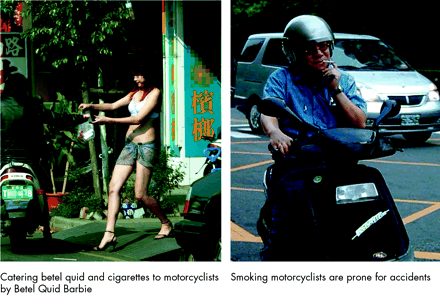
One suggested mechanism for the strong association is that smokers suffer from “nicotine withdrawal” symptoms, such as irritation and listlessness, most of the time when not smoking.27 In UK, increased workplace accidents were recorded on the “No smoking day” every year between 1987 and 1996, when large number of smokers attempted to abstain from smoking on those days.28 Some have described smokers as having “performance decrements” while abstaining, as their mood and cognitive performance deteriorates within a few hours of beginning to abstain.29 Smoking while driving a car has been shown to increase the number of accidents and mortality risk.30–32 Distractions, lapses of manual dexterity, or blurred vision from smoke have all been suggested as responsible mechanisms of increased injury.33 In Taiwan, the smoker’s injury risks could further be exacerbated by riding motorcycles, since more than half of the male adult population in Taiwan owns motorcycles34 and 60% of all MVA mortality involved motorcycles.35 Thus, it can be argued that the smoking behaviour of motorcyclists may have played an important role. In fact, it is not uncommon to sight “smoking cyclists” on the streets in Taiwan.
Another contributing factor is the potential for smokers to inadvertently start fires. Burning cigarettes are a fire hazard, especially near flammable objects. Smoking is the leading cause of deaths from residential fires in the USA, and nearly one third of deaths by burning were caused by cigarettes.15 With an average of 200 deaths a year from fire in Taiwan,24 approximately 1.3 such deaths a week can be associated with cigarette smoking.
Impaired ability to recover from injuries in smokers may add to the death toll. This includes poor wound healing, delayed bone union, decreased blood flow, diminished tissue oxygenation, diminished immunity, increased wound infections, and more severe pulmonary complications among injured smokers.15,16 All of these factors increase morbidity and make complications more serious in smokers, leading to increased mortality. For this reason, surgeons prefer or even require smokers to quit smoking weeks before elective surgery.16,36
Smokers may have a higher propensity for risk taking,37 by not wearing a seatbelt in cars,32 having more traffic violations,31 or driving while drunk.30 In addition, workers who smoke cause more workplace injuries than non-smokers.6,33,38 Our data also suggest Taiwanese smokers have increased job related injuries.
When smokers quit in Taiwan, their excess risks for accidental deaths seem to disappear. This reduction of injury risks almost immediately after quitting has been reported,39,40 and is in sharp contrast to the much slower reduction of ex-smoker’s risks from other causes, such as coronary heart diseases or lung cancer.41 In a number of randomised trials in which smokers were randomised to smoking cessation programmes, the association between smoking and injury emerged.39,42 Thus, it is particularly encouraging for promoting smoking cessation to reduce fatal injuries.
Historically, smokers have claimed their right to smoke as long as smoking does not affect others. In this regard, societal concern has been mainly limited to the risk of non-smokers from exposure to second hand smoke, particularly when young children were affected. However, the fact that non-smokers may be at increased risk for various injuries (for example, fire, MVA, and job related accidents) caused by smokers has not been widely recognised. The right of smokers to smoke should be qualified accordingly, as we begin to realise the potential effect on others’ lives and property. Currently like drinking, smoking remains a private pursuit unless others are hurt or killed. When more of this is understood and communicated widely about the association between smoking and injuries, society may view smoking differently.
What this paper adds
Smokers have higher injury rates than non-smokers, even when alcohol and social class are considered. In Taiwan there are significant relations between dose (daily smoking amount) and response (injury death). Over one fifth (23%) of all male injury deaths in Taiwan were associated with smoking. Smokers have more motor vehicle accidents in Taiwan, partly because many smoke while riding motorcycles.
Suicide was increased among smokers in Taiwan, but the small sample size may have limited its significance. Mechanisms to explain the increased suicide risks in smokers are complex, as situations differ.43,44 The relation between smoking and suicide could be a direct one when smokers became inflicted with morbidity, but it could also be an indirect one,15 through the mechanism of depression, as smoking is associated with depression45,46 and depression is associated with suicide.43 This conclusion has been questioned.44,47
Smoking in Taiwan is mainly a male behaviour and the increased injury risk has been limited to males in this study. The smoking or drinking status was self reported at the time of recruitment and may introduce recall/reporting bias. This potential bias cannot be quantified based on data collected for this study. Drinkers in this study were defined as those who admitted in the questionnaire to be a regular alcohol user, in contrast to an occasional or party drinker. Due to the lack of detailed drinking data (for example, number of drinks per week) among some cohort members, a more precise quantitative analysis of alcohol use cannot be made. We conducted only one to two surveys at the intake and not afterwards, so smoking and drinking behaviours may have changed over time. This may lead to a non-differential misclassification of smoking and drinking status. However, it is important to note that most of the cohort members were adults over 25 years of age, when non-smokers becoming new smokers are rare, accounting for only 1.2%.48 As a result, there would be more smokers who quit afterwards than non-smokers who became smokers. The fact that we included these ex-smokers in our cohort as smokers would probably underestimate the mortality risk. However, the quit rate among smokers in Taiwan has been relatively small, with the cumulative lifetime ex-smoker amounting to one seventh of the smokers.23 Thus, the impact of the misclassification is likely to be small. Another limitation of this study is that only fatal injuries were included. Presumably, for every fatal injury, there were many more injuries that were not fatal, and thus the true burden of injury from smokers has been grossly underestimated in this study because only mortality was considered.
In summary, smokers in Taiwan have been at increased risk of mortality from accidental injuries of all types, and this risk increase is dose dependent. Smoking was associated with at least one out of every five male injury deaths in Taiwan. Quitting smoking would reduce these risks. Through accidents, the hazards of smoking are not limited to smokers themselves but affect smokers and non-smokers alike. That smokers exhibit such a high liability has not been publicised to smokers or non-smokers.
REFERENCES
Footnotes
-
Competing interests: none declared